
The Supreme Court's order to remove stray dogs from Delhi-NCR localities has sparked mixed reactions, with RWAs welcoming the move and animal rights activists raising concerns about implementation and potential harm.

'Day by day we expose how soulless we have become as a society. Every day is a disappointment.'
A five-judge Constitution bench of the Supreme Court is scheduled to consider the Presidential reference on whether timelines could be imposed by judicial orders for the exercise of discretion by the President while dealing with bills passed by state assemblies.
A Constitution bench comprising Chief Justice B R Gavai and Justices Surya Kant, Vikram Nath, P S Narasimha and A S Chandurkar, would fix the timelines on July 29 and commence hearing on the presidential reference in mid-August.

Anurag Kashyap has expressed his frustration over the release issues faced by Ananth Mahadevan's biographical drama Phule.

A woman is never free, bound as she is by so many expectations. And the one that can destroy her -- just as much as it can make her -- can be summed up in just one word. Mother.

It this era of sensationalism, we should appreciate director Anant Mahadevan for treating Phule with calm and composure and not going overboard, notes Hemant Waje.

The 19-member National Syllabus and Teaching Learning Material Committee (NSTC) will be headed by National Institute of Educational Planning and Administration (NIEPA) chancellor MC Pant and develop textbooks for classes 3 to 12.

The Supreme Court of India has ruled that courts have the authority to determine the appropriate interest rate in cases involving share valuation, considering the specific facts of each case. The decision came in a 52-year-old legal battle between private parties and the Rajasthan government over the valuation of shares transferred to the state government. The court also modified the interest rate applicable to delayed payments, awarding 6 percent per annum simple interest from July 8, 1975, until the date of decree, and 9 percent per annum simple interest from the date of decree until realization of the payment.

Joginder Tuteja looks at the month's releases in theatres.
The Supreme Court of India has reprimanded the Rajasthan government over the alarming rise in student suicides in Kota. The court expressed its deep concern over the situation, questioning the state's efforts to address the crisis. The court also ordered an FIR to be filed in the case of a 22-year-old IIT Kharagpur student who died by suicide in his hostel room, citing a delay in reporting the incident to the police.

'Casting the Bachchans NOT as father and son was the toughest and the easiest part.'

Reader Parag Desai and his family met the singer in the US.

The Supreme Court of India has directed its registry to call for a report from IIT Kharagpur and Kota, Rajasthan, after the suicides of a student and a NEET aspirant came to light. The court is seeking to ascertain whether FIRs were registered in both cases, highlighting the disturbing pattern of student suicides in educational institutions. The court has also previously ordered the formation of a national task force to address mental health concerns and prevent suicides in higher educational institutions.

'We should support cinema that's rooted in our culture and not ape the West.'

'It pains me when Marathi film-makers come to me and say that Marathi cinema is not getting the right platform.'

Tamil Nadu Chief Minister M K Stalin has welcomed the Supreme Court's ruling that state governors must give assent to bills passed by state assemblies, calling it a 'historic' victory for all state governments in India. The court's decision came after the Governor of Tamil Nadu, R N Ravi, withheld assent to several bills passed by the state legislature. The court found that the governor's actions were in violation of the Indian Constitution, which mandates that governors must act on the advice of the council of ministers. The ruling is seen as a significant step towards strengthening the federal structure of India.

Tamil Nadu Governor R N Ravi has sparked controversy by asking students at a government-aided college in Madurai to chant "Jai Shri Ram". The State Platform for Common School System-Tamil Nadu (SPCSS-TN) has demanded his removal, alleging that he violated his oath of office and secular principles. The group claims Ravi's actions were against the Constitution, which outlines India as a secular country and emphasizes the importance of upholding secular values in education. The incident follows a recent Supreme Court ruling that overruled Ravi's decision to withhold 10 Bills passed by the Tamil Nadu government, highlighting ongoing tensions between the Governor and the state administration.

Reader Sumedh Acharekar has sent us a photograph.

'He was a tremendous artist of a very high order, gone too soon. He not only reshaped the visual language of Indian Cinema through his cinematography in Aravindan's films, Shaji sir gave us all a sense of direction through his mainstream work as a cameraman.'
Justices N Kotiswar Singh and R Mahadevan were on Tuesday elevated as judges of the Supreme Court.

The Storyteller has a lot to like and admire about it, observes Mayur Sanap.

Over 5,000 folk and tribal artists from across India performed 45 dance forms during the 76th Republic Day celebrations. The 11-minute cultural performance, titled "Jayati Jaya Mamah Bharatam," was curated by the Sangeet Natak Academy and showcased the rich legacy of tribal and folk art forms. The choreography celebrated themes of "Viksit Bharat," "Virasat bhi Vikas bhi," and "Ek Bharat Shreshtha Bharat." The performance, which covered the entire Kartavya Path for the first time, highlighted youth power, artistic heritage, and women empowerment.

The Supreme Court of India has taken a strong stance against child trafficking rackets, canceling the bail granted to 13 accused and criticizing the Uttar Pradesh government for its inaction. The court expressed concern over the rising number of trafficking cases and the changing patterns of the crime. It also directed the state to ensure trafficked children are admitted to schools and receive support for their education.

The Supreme Court of India has ruled that Tamil Nadu Governor R.N. Ravi can no longer serve as chancellor of state-run universities, a decision welcomed by the ruling DMK party. The court's judgment stems from a long-standing dispute between the state government and the governor over the assent of 10 bills passed by the Tamil Nadu Assembly. The DMK alleges that the governor had obstructed the smooth functioning of universities by delaying appointments and other critical matters. The judgment paves the way for the Tamil Nadu government to appoint new chancellors for its universities, effectively removing the governor's influence in higher education.

'We want to hide it (by saying) we are too busy in our lives, we have other things to attend to, we have families.' 'But they all had families, including Jyotiba or Mahatma Gandhi, or anybody who challenged the system.'

rediffGURUS Dr Chandrakant Lahariya, Komal Jethmalani, Dr Karthiyayini Mahadevan and Pushpa R will answer your diabetes-related questions.

President Droupadi Murmu has exercised powers under Article 143(1) used in rarity to know from the Supreme Court whether timelines could be imposed by judicial orders for exercise of discretion by President while dealing with the bills passed by state assemblies.

Sukanya Verma celebrates Hrithik Roshan's silver work anniversary with a playlist of 25 of his chartbusters.

The Supreme Court of India has agreed to hear on May 6 the pleas of the Kerala government against the governor over the delay in approving bills passed by the state assembly. The court will consider whether the issues raised in the Kerala petition are covered by a recent judgment on a similar plea by Tamil Nadu, which set timelines for governors and the President on granting assent to bills.
A bench comprising justices J B Pardiwala and R Mahadevan on April 8 gave a huge relief to the Dravida Munnetra Kazhagam-led Tamil Nadu government and cleared 10 state bills which were stalled and reserved by Governor R N Ravi for President's consideration, and also set a timeline for all governors to act on the bills passed by state assemblies.

Reader Ravindra Kshirsagar sends us a photograph.

The Supreme Court of India has ruled that governors cannot indefinitely delay giving assent to bills passed by state legislatures, setting a timeline of one to three months for their actions. The court said the governor must act "as soon as possible" and that failure to comply with the timeline will make their inaction subject to judicial review. The ruling comes as several opposition-ruled states have accused governors of delaying assent to bills passed by their assemblies.

'It's important to keep doing your work. Do what you understand and don't expect much.'
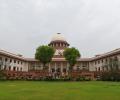
A Governor does not possess any discretion in exercise of functions under Article 200 of the Constitution in respect to any bill presented to them and must mandatorily abide by the advice tendered by the council of ministers, the Supreme Court has held.


Unless Governor Ravi or the Union of India moves in appeal, seeking a hearing by a constitutional Bench, this is where it all will have to end, observes N Sathiya Moorthy.

In a landmark verdict, the Supreme court fixed a timeline for Governor to act on bills passed by the state legislature as it pulled up Tamil Nadu Governor R N Ravi for reserving 10 bills for President's consideration, saying it was against the constitutional provisions.

'When Kamal Haasan came into the room, I was literally shivering. I am just an ordinary head load worker and there, I was standing next to a legend like him. I didn't know what to do. Not even in my dreams did I think of meeting Kamal sir or talking to Shankar Mahadevan sir. I was living a dream.'

Four days after the top court cleared 10 bills, which were stalled and reserved by Tamil Nadu Governor R N Ravi for the president's consideration, and set a timeline for all governors to act on the bills passed by the state assemblies, the judgement running into 415 pages was uploaded on the apex court's website at 10.54 pm on Friday.
 © 2026 Rediff.com - Advertise with us - Disclaimer - Privacy Policy - Sitemap - Feedback - About us - Terms of use - Grievances